
UME

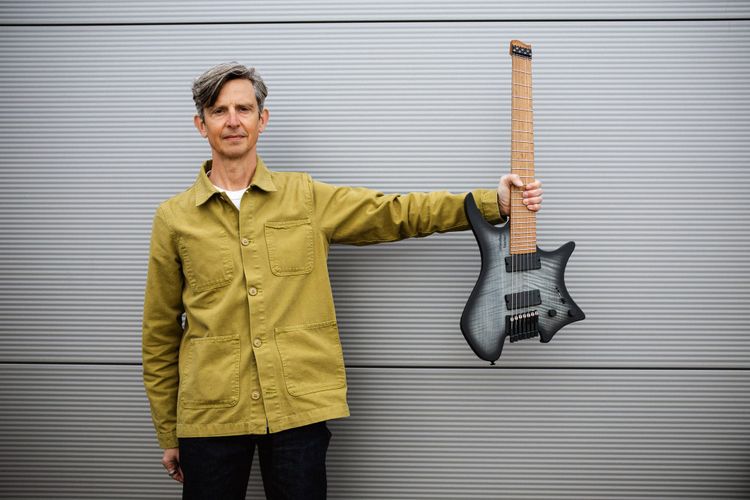
Over a decade ago, I designed a new guitar model that I called UME. UME is the airport code for Umeå, Sweden - my birthplace, and where I grew up. Umeå is also the birthplace of many incredible bands, for example Meshuggah. So UME is a homage to the city of Umeå, including the duality of winter darkness and summer light, of peace and quiet and the heaviest metal music, and of "U" and "Me".
The background is that the Varberg design was originally intended to be composed of interchangeable layers and assembled with screws, making it possible to for example replace the core (middle) layer with one that had a different outline, making it rest differently in the lap when seated, and placing the right arm at a different position for optimal comfort. However, I scratched that idea on the drawing board, due to the risk of the different layers warping, shrinking and expanding independently, which would be hard to deal with.
So one design objective of UME was to simplify the layer structure by using two thicker layers that would be less susceptible to warping. I prototyped various ways of housing the electronics, both conventionally in a cavity and in a separate module that would be attached to one layer or fixed by the assembly of the layers. The neck fastening could be part of the assembly as well. This would make the guitar modular in many respects. I toyed around extensively with the thought of housing a separate "tone block" where the bridge would be anchored. If the remaining guitar could be made as neutral as possible in terms of how it colors the sound, the (replaceable) tone block would provide the character.
But I could not bring myself to complete the design... My ideas were solutions looking for problems to solve, instead of the opposite. They were cool concepts emerging from an engineering perspective, and not innovations that addressed player needs. I was simply not able to resolve the design decisions needed, and despite a few attempts to bring it to life over the years, it has remained in the proverbial desk drawer.
But then at the 2026 NAMM Show, I met someone with needs that are beyond what any current guitar on the planet can meet - just like when I met Tosin Abasi when I was just starting out, and the extended range Boden design was born. Talking to them more and more and understanding the limitations of current instruments, and the problems to be solved, I realized that I was answering the open design questions for the UME design!
Suddenly, it morphed into a new design with body modules, a neck module, and several adjustable components that will allow the instrument to be configured to the player from both the ergonomic and sonic perspectives.
Coming blog posts will take you through some of the design elements as they are resolved. One thing I will mention is that it will feature a headstock of sorts... "A headstock!?" you say? 😄 Well, current .strandberg* guitars are headless for a reason (many reasons!) but there are also reasons and design justifications for a headstock. For example:
- The non-vibrating part of the string between the nut and the string anchor on the headstock (i.e. usually the tuning machine) influences how the instrument feels to play - bending strings, for example. This is the reason some players talk about headless guitars as "feeling stiff". A "normal" and reverse headstock 6 in-line, or a 3+3 configuration will behave differently in these respects.
- The (string anchoring point at the) headstock contributes to how the strings vibrate and the tone of the instrument. The lack of a headstock, or the material will contribute character to the sound.
- The lack of mass at the headstock can to some players feel unfamiliar to the point that it is not enjoyable.
To this player, all of these things were real issues that need to be resolved. So the pieces fell into place, and the UME design now has a modular headstock that will address all these issues. Additionally, to meet the sonic needs, it makes perfect sense to open source the body modules and put them in the public domain, to allow creatives to construct custom personalized modules.
There are many more things to reveal and discuss. Ultimately, the identity of the mystery player will be revealed as well, but let's keep that a secret for now. The next blog post will probably be about a new truss rod solution, which I think is needed.
Also - no AI was involved writing this post.
AI Panel Commentary
The panelists:
Blaine Segway - moderator (female, but the others think she is male)
Iain Footnote - brand historian, knows "everything" about the brand
Daiter Lesmore - knows Dieter Rams' 10 Principles of Good Design like his own
Kai Fretwell-Wayback - pro musician and general skeptic
They were created as prompts in Claude, and asked to comment on the post above in order, including to react on what anyone before had said. The script was then uploaded to ElevenLabs and voices assigned to the respective text blocks. No edits were made to the script that was generated.
Feel free to continue the discussion in the comments!
Member discussion