
Reboot - Building the blog (the blog about the blog)
FOREWORD
So, just for full disclosure - I set this blog up a couple of months ago, and wrote a few illustrative posts to share with various stakeholders within the company before going live. Transitioning from running the daily R&D operations in a successful company with a whole team and supply chain, back to having free reins as a one-person show again is a pretty big (and exciting!) deal, so I wanted to make sure that everyone was on board. Even though my instinct was to re-write this first post before going live, I have not changed anything material in any of the sample posts I wrote. Just unpublished the last ones to give you time to catch up. Two things have changed though: I tested the AI-panel idea, and I think it works, so it is there already; and from the first iteration, I have also added my own reactions to the panel's discussion.
In the time between writing the first few posts and now, "DAddario-gate" happened, and the pushback against AI in the music community has increased even more. I vow to be open about when I use AI, and what for. Because I do use (at the time of writing this) Claude as a research tool almost on a daily basis.
I have produced various guitar-related things in the public eye for almost 20 years now, and often reflected over the difficulty of anticipating the reaction of the audience. So using the synthetic personas in the panel is an experiment to see if I can do this better, and if they can keep me in line with expectations. :)Let's make this fun and engaging in good faith, together!
Ola Strandberg 31 August, 2026
There's something a little absurd about writing a build-log entry for the blog itself before there's a single post on it. But that's the whole point of doing this in the open again — the mess is the content, not just the finished thing. So: here's how the workshop got built.
What is a blog in 2026?
I prompted Claude (please see the sections below how I justify this) the following:
This project is for restarting my personal development blog (2007-2008 style build-log, now for 2026).
Background: From 2007/2008 until 2015 I ran a WordPress blog (archived, partly broken, at guitarworks.thestrandbergs.com) documenting the build of what became the Boden guitar. It mixed long build-log entries, short notes, dead ends, sound/video clips, and customer-project posts, organized loosely by category and month. I invited others to participate and licensed everything under Creative Commons (originally BY-NC-SA 3.0). I'm now burnt out again and want to recapture that explorative, in-the-open process.
As far as I can tell from the thread that ensued, the blog format is still relevant. So, the question is how/where to host a blog in 2026? I knew about for example Squarespace and Substack, but Claude suggested Ghost, which seemed like a great option for what I was looking for. In particular, the blurred line between blog and newsletter appealed to me. And it's open — I can export everything, self-host if I ever want to, and the whole publishing model quietly rhymes with putting this content under Creative Commons in the first place.
Edition over Ease
With Ghost selected, I needed a theme (which defines the layout), and without having a firm grip on what a blog is in 2026, I again asked Claude. It suggested two free themes: Edition and Ease. Ease is Ghost's own documentation theme and has a search bar front and center (but it turns out it doesn't actually search anything without extra plumbing). It kind of makes sense for the blog to be search-centric, but on the other hand, I am not trying to build something to become a reference. It's about telling a story and chronology matters, so the "Sign Up" call to action front and center makes sense, even if collecting followers is not the objective this time around either. The Edition theme assumes someone showed up to read a story, not look something up. That's this blog.
The first mockup
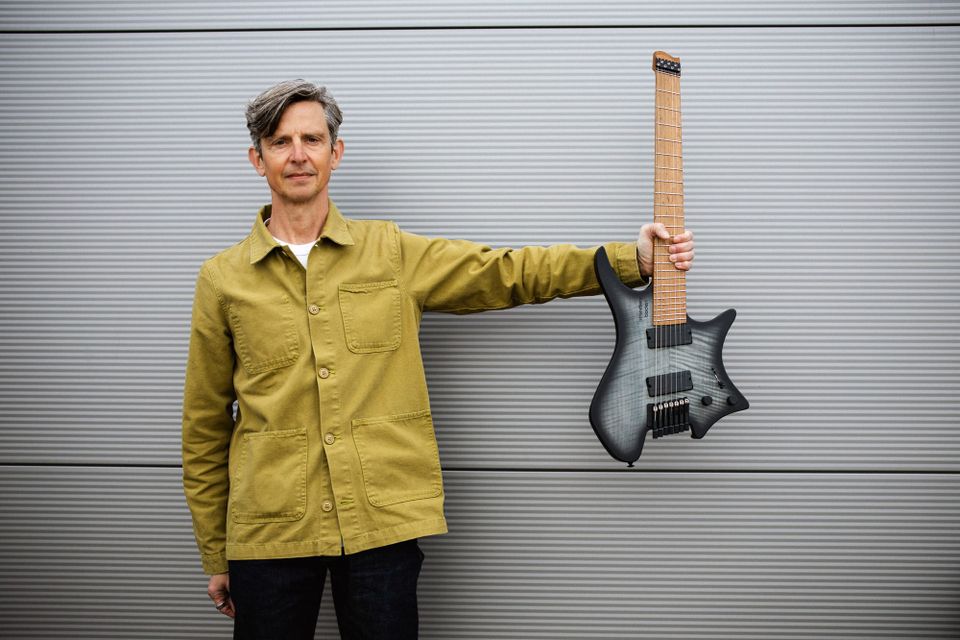
I remember from the old Wordpress days the feeling of hopelessness when the beautiful theme you installed became very lack-lustre without the cool images from the demo. So, I wanted to keep the layout extremely simple and with images optional. Not knowing exactly what this blog will be about except it will probably have a lot of guitar stuff in it, it's ok that the look and feel is "Ola" and centered around me and not the .strandberg* brand. So I let Claude build a mockup of the Edition homepage using a photo of me with a guitar and suggest various elements, and I was happy with that.
I considered finding a way to tie the blog visually to .strandberg* but chasing a "brand color" would've meant the green color we use for the logo. But this blog should be separate from the brand, so for now I'll just keep it simple. But I have a feeling I will re-visit this later. My custom bikes actually carry a logo with a nudge towards .strandberg*, that I developed a long time ago, so I might re-use it (EDIT: it is now the logo on the top of this page).
The license, taken seriously
I want to maintain the Open Source/copyleft idea of the original blog. The current version of Creative Commons is 4.0, so the full license that means Attribution + Non Commercial + Share-Alike is CC BY-NC-SA 4.0, the same spirit as 2007. This was probably the most misunderstood aspect of the old blog. I'm still struggling with deciding how big of a deal this is, and how much in your face I want to be about it. Some of the things I will document here will be intended to become commercial Strandberg Guitars products, but I still see the value of keeping the design process public instead of keeping it under wraps for a big unveiling when it's done.
Other things will be intended for public use and for the benefit of the guitar community, and come with an invitation for participation in the design process. I am not counting too much on the latter though - it was the main objective of the original blog, but few took advantage of it. Plenty people built clones and copies, but I don't think I have seen a single one that has made improvements and then shared those improvements with the community under the same license, which is what the license requires. Plenty of guitar builders have violated the license by incorporating licensed materials for commercial purposes (ie. accepting a client request for something licensed). Not out of malice, but just by not understanding, or not noticing.
If you are a hobbyist like I was back in the day, please do use what you might learn studying my work here! I encourage you to think about how it can be improved, and share those improvements with the world, rather than just copy something though. This will be more fun and more rewarding.
What's coming (maybe)
I don't want this to just be a project build-log with a new coat of paint. The whole point of doing this again is the workshop feeling — half-finished ideas lying around where anyone can trip over them. So some of what shows up here will be early, rough versions of things that might one day actually become a .strandberg* product. Some of it won't. Some of it will just be a thing I got curious about on a Tuesday that has nothing to do with guitars (probably something to do with cycling) at all, or a reflection that doesn't resolve into anything. I'm still an employee of Strandberg Guitars, so contractually my guitar related work belongs to the company and not to me personally. I'm not trying to re-run the old blog's greatest hits. I'm trying to get back the feeling of learning something because it's interesting, before I know what it's for.
About AI
One of the threads I want to explore is AI, and I'll be honest that right now it sits closer to fear than excitement. The musician community I've spent my whole (late-in-life) career in is in a justified turmoil over generative AI — a lot of people I respect see these models as trained on work that was taken without consent, credit, or payment, and I think that reaction is very reasonable. I license everything here CC BY-NC-SA specifically because I believe credit and consent matter. That makes using AI tools myself a genuinely uncomfortable position, not a hypothetical one.
So I don't have a tidy answer for what "ethical AI use" looks like on this blog, and I'm suspicious of anyone who claims they do. What I can do is work it out here, in public, the same way I'd work out a bad truss-rod idea: show my reasoning, admit when I don't like an answer, and let you push back in the comments. A few things I'm leaning toward, none of them final — being explicit whenever AI touched a post rather than quietly smoothing it in, treating it as a research and drafting tool rather than something that generates the music or the design itself, and keeping a genuinely skeptical voice in the room rather than only ones that agree with me.
One idea that came to me as I was waking up this morning was to include a commentary panel made up of AI personas that react to each post in a podcast format. We will see what comes of it, but it would definitely include a skeptical traditional musician — I want the pushback baked in — and also a Dieter Rams (one of my heros) gatekeeper keeping me in line with the 10 Principles of Good Design. Probably also a historian the can keep track of what I may have forgotten.
Worth naming the obvious irony: I used Claude to help draft parts of this very post. That's not a contradiction I've resolved, it's the actual live version of the question. Figuring out where that line sits, honestly and out loud, is itself one of the things this blog is for. I am far from having trained the model to represent my voice, so there has been significant "manual" editing, but just to explain how it came about: I started the chat as described above in the intro and kept conversing and checking things out, and at the end of it I asked Claude to create a summary of what we had discussed as the first blog post. A lot of very insignificant things got their own entire paragraphs, so I have deleted a ton. Other things were excluded entirely, so I have written them myself, which I find quicker than to try and re-prompt until I get the result I want.
What's still not done
No posts yet. No AI commentary panel — still just an idea, still needs actual persona prompts before anything gets prototyped. This entry is the "before" photo. Next real post should probably be an actual project idea.
EDIT: And... The AI Persona Commentary Panel!
I couldn't help myself trying out the creation of a AI persona commentary panel before even going live with this new blog. I am intrigued by the results! Again as mentioned above, some small things got more attention than expected and some large things got less. But all in all, I think a lot of what is being discussed is relevant, and a good start of the discussions. I look forward to what they say later on - I will definitely keep the panel going for a while longer and see how it evolves.
Here is the discussion between the panelists:
Blaine Segway - moderator (female, but the others think she is male)
Iain Footnote - brand historian, knows "everything" about the brand
Daiter Lesmore - knows Dieter Rams' 10 Principles of Good Design like his own
Kai Fretwell-Wayback - pro musician and general skeptic
They were created as prompts in Claude, and asked to comment on the post above in order, including to react on what anyone before had said. The script was then uploaded to ElevenLabs and voices assigned to the respective text blocks. No edits were made to the script that was generated.
Feel free to continue the discussion in the comments!

Member discussion