
Bikes vs Guitars
I don't really identify as a "guitarist" although I know all positions of the pentatonic scale and a bunch of chords, and can work myself through some songs. I do, however, identify very much as a "cyclist". Not simply because I can keep my balance on two wheels, but because I have probably put in the mythical 10,000 hours needed to master something on a bike.
I have thought quite a bit over the years about similarities between bikes and guitars. As products, they come in similar price ranges, and buying one over another is often an emotional process, and different brands come with different "cred" and values. Where they might differ slightly is that the primary by the industry stated objective for a (race) bike is to get from point A to point B as quickly as possible, and there are some objectively measurable properties of a bike that may have an impact in this regard. While many guitar players put in a lot of effort to play as many notes per second as possible, it is not a statistic that is worked towards in product development. The best cyclist in the world could never win a race on a "bad" bike, but plenty guitarists perform amazing music on "bad" guitars.
As objects, bikes and guitars have many analogous properties that the discernible rider/player will care about:
- Scale length and number of strings for a guitar create different categories of instruments (6-/7-/8-string, baritone, bass, etc.) just like overall geometry with tire clearance and suspension create different categories of bikes (road race, road endurance, gravel, XC MTB, downhill MTB, etc.).
- The bike frame is (obviously) the equivalent of the guitar body. This can be made from different materials, like steel, aluminium, titanium, and carbon, all with their distinctive ride feel properties. Just as with the guitar, it is the defining component that everything else is attached to.
- The fork is to the bike what the neck is to the guitar. It makes a massive difference to how the bike rides, and different categories of bikes may differ primarily in how the fork is constructed. It can be replaced, but rarely is.
- The drivetrain (cranks, chain, gears, etc.) fills a similar function to the pickups and electronics in an electric guitar. Just like the pickups in the guitar is what sets a lot of the character of the sound that comes out, the drivetrain decides what the bike can do. Upgrading these components makes a massive difference, and there is a big correlation between price and performance.
- The brakes are central to the function of the bike, just like the tuners and bridge are to the guitar. Skimping on quality of these parts may still result in a functioning whole, but caps the total function. A bike will roll just as fast with bad brakes, just like a guitar with bad tuners can play just fine. On contrast, well functioning parts are a pleasure to use.
- The wheels, including the tires, have a similar impact as the strings on a guitar. Like different string gauges and materials completely changes the playability and function of the guitar, the dimensions and materials of rims and tires of the bike wheels completely change what the bike can and cannot do. Furthermore, these are wear and tear components that need to be replaced periodically. They are probably the lowest cost upgrade.
- Then there are all the additional components, like handlebars, saddle, pedals, bottle cages, etc, which might be too detailed to get into, but may correlate to nut, fretwire, knobs, strap buttons, etc. Notably though, the purpose of the curly handlebars ("drop bars") on race bikes is to give several different seated positions to alternate between on long rides, just like the leg cutaway on a .strandberg* guitar allows you to change the guitar position in your lap during a long playing session
"Fit"
All of the above is fairly well understood, but one thing that is much less talked about for guitars than it is with bikes is the concept of "fit", as in how the dimensions and distance relationships between the components are optimized for the player/rider for the intended use. A dedicated cyclist spends about the same time riding as the dedicated guitar player spends time playing, but the fit is considered a big deal for a bike whereas it is largely ignored by guitarists.
Every guitar player knows that different guitar models play differently. Weight is a property that is often carefully considered, and some body shapes can make playing awkward. A larger body shape places the bridge and strings higher off the lap when seated. The outline of the body and presence or lack of an arm bevel will influence the angle of the forearm in relation to the bridge, and the height of the bridge from the top of the guitar changes how the right hand and wrist are positioned. The dimensions of the neck are very important, and some players care about things like fretboard radius, string spacing, and so on. You can commission a custom guitar to tailor these things to your needs, but generally, a guitar model is what it is.
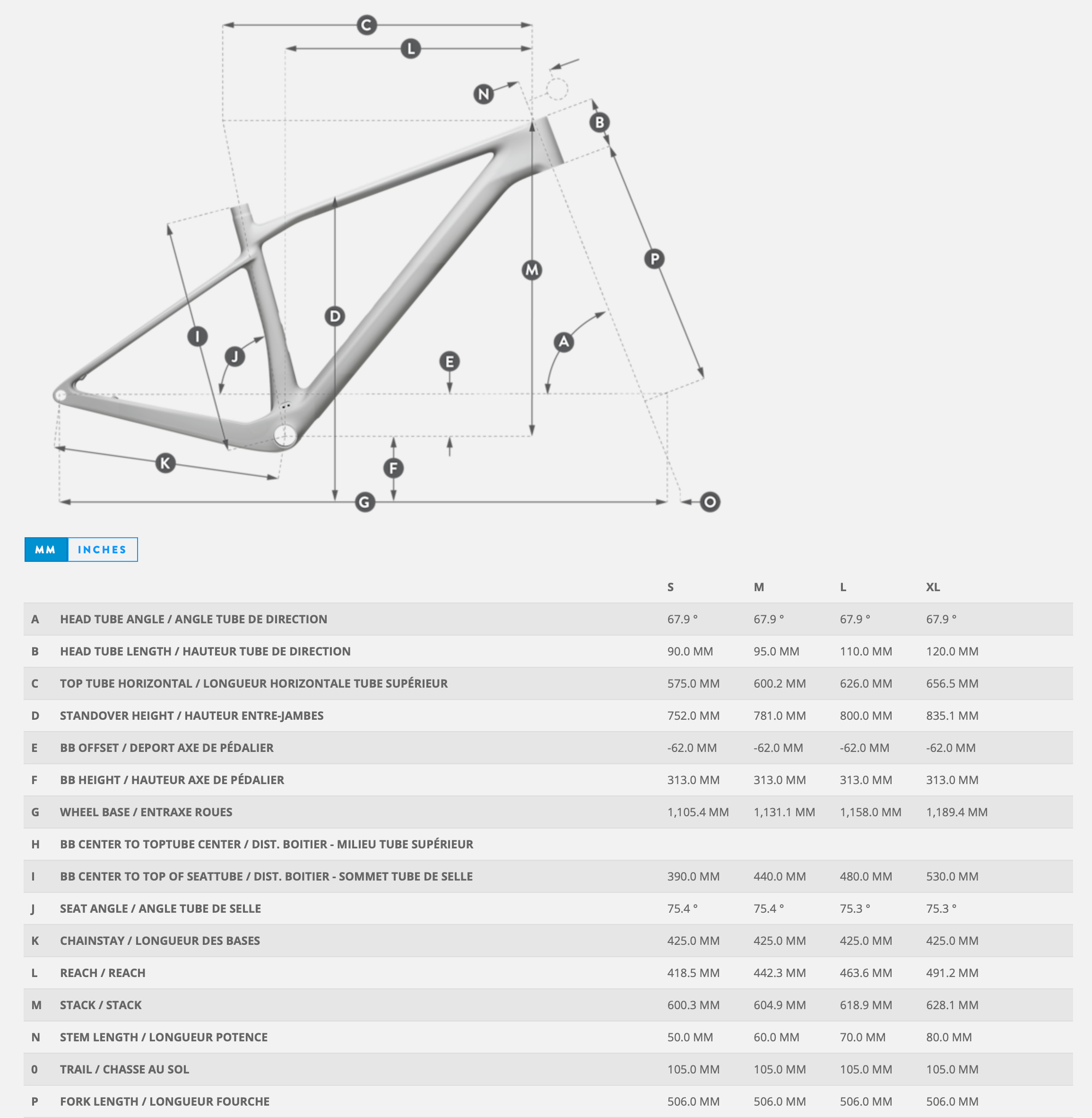
Bike manufacturers list the dimensions that determine how a bike will ride publicly for comparison. Stack and Reach are among the most important for bike sizing. Head tube angle, trail, chain stay length, wheelbase, bottom bracket offset and height all influence greatly how the bike will handle, and I can make a lot of guesses about this by just looking at the website.
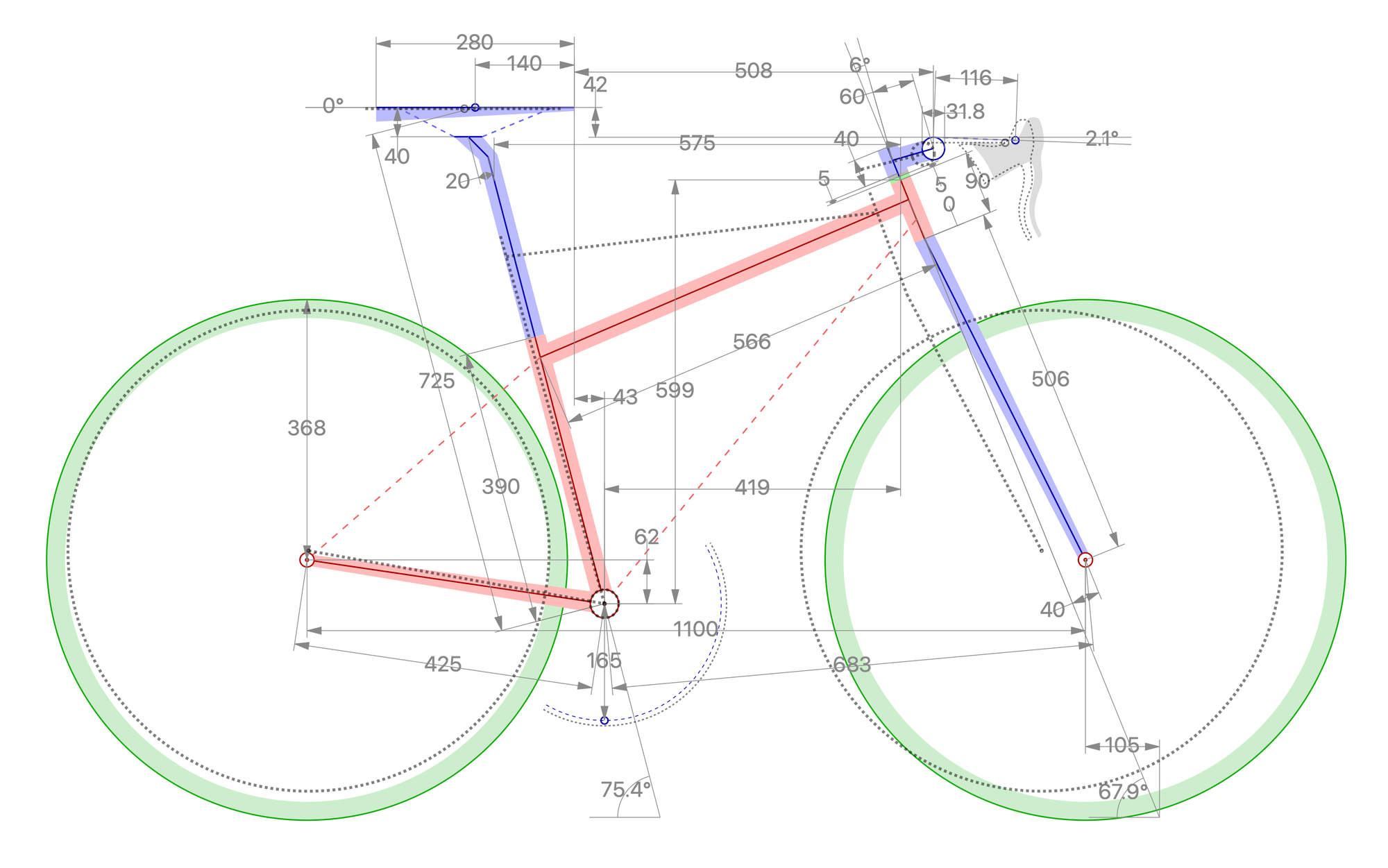
The image above shows a screen grab from the bikegeocalc online bike geometry editor. The green/red/blue elements are for the Scott Scale RC mountainbike from the table above, configured as a drop-bar MTB, overlaid on the dashed line counterparts of my gravel bike. My gravel bike was custom made for me, with every angle and dimension tailored to my body from riding on a rig similar to what you can see further down on this page. By grabbing the dimensions for the MTB frame from the manufacturer's website, I could use the bikegeocalc website to overlay the various Scott Scale RC frame sizes to determine which one to choose, including which stem length to choose, and thereby sanity check that it could be adjusted to fit me perfectly.

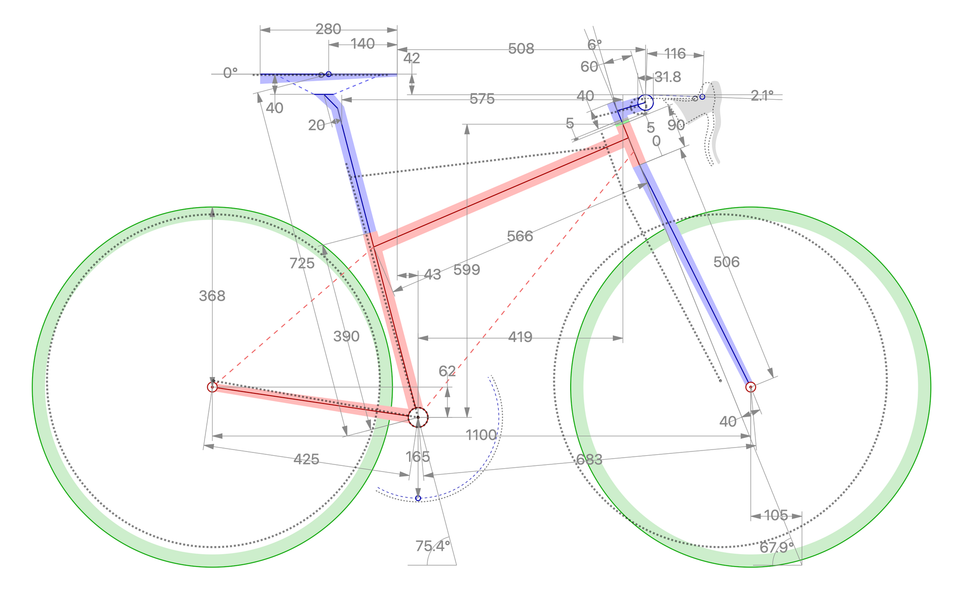
On a bike, the "contact points" are the saddle, the pedals, and the handlebars. They determine your position on the bike, and your physique, fitness, and type of intended riding will determine how to position them relative to each other. You will select a frame size that puts you in the ballpark, and then everything is adjustable: seat post setback, saddle height, saddle fore-aft, crank length, handlebar stem length, the handlebar dimensions, handlebar height, etc. There is a massive ecosystem of parts (many dimensions have de facto standards that allow interoperability) and bike fitters to help make these adjustments. They also need to be revisited periodically, since your fitness influences the decision-making. The image above shows me during a refresh bike fitting session at PainFreePower in Stockholm, where we simply looked at things like seat and handlebar position on my existing bike.
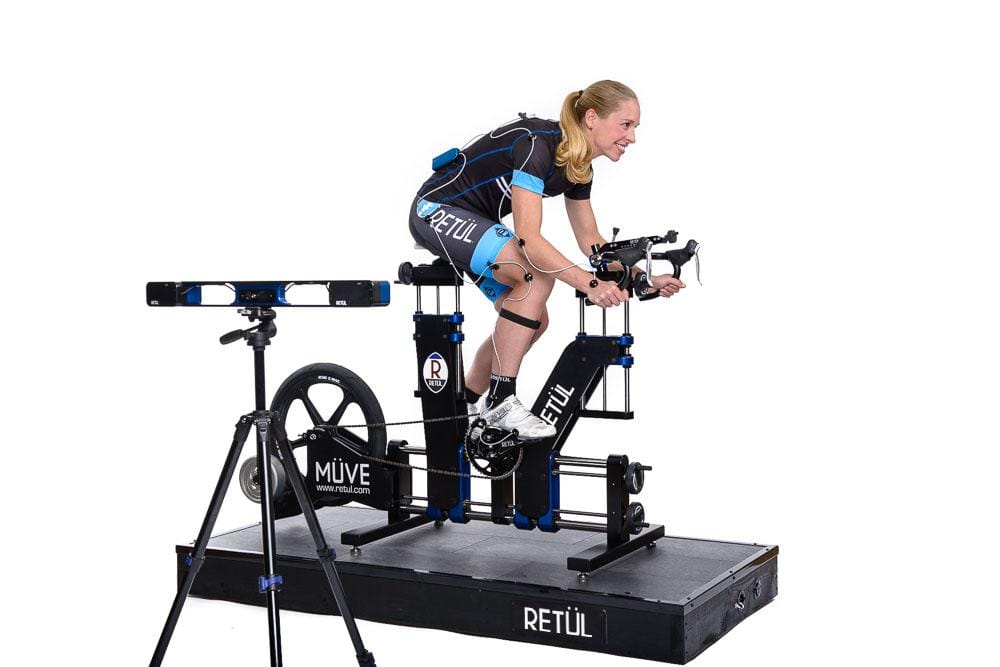
But often, a bike fitting rig looks like the above. The saddle and handlebars can move in two dimensions as well as rotated while riding, and by using video analysis and power measurements, the efficiency of pedaling can be optimized for the rider in real time.
A "guitar fit"?
So what does a "guitar fit" look like? Which are the critical measurements? And are the measurements relevant when comparing guitars? Is there a case for different sizes of the same guitar model? What can be fixed, and part of the model characteristics, and what needs to be adjustable? What needs to be adjustable only at the time of purchase/once per year, and what should be adjustable at will, like for a specific practice session?
More importantly - the behavior (by this I mean not only the sound, but the sensation of playing it, including the tactile feel and vibrations against your body and hands) of a guitar really is influenced by every single component, including how the component is attached to the guitar. The materials of body, neck, and fretboard; whether they are glued or bolted together; the material of the bridge and saddles, and how they are attached, and so on. So if a guitar is made adjustable, to what extent can you preserve these behaviors across the adjustment range? I learned a lot about this from the Meloria project.
Or maybe a guitar doesn't have to be adjustable? Maybe we just need a terminology to capture the key measurements to allow you to pick out guitars that work for you?
I will try to answer at least some of these questions in the context of the future development of the UME model! What do you think?
Again - no AI was used in writing this post.
AI Panel Commentary (+ Podcast!)
The panelists:
Blaine Segway - moderator (female, but the others think she is male)
Iain Footnote - brand historian, knows "everything" about the brand
Daiter Lesmore - knows Dieter Rams' 10 Principles of Good Design like his own
Kai Fretwell-Wayback - pro musician and general skeptic
They were created as prompts in Claude, and asked to comment on the post above in order, including to react on what anyone before had said. The script was then uploaded to ElevenLabs and voices assigned to the respective text blocks. No edits were made to the script that was generated.
Feel free to continue the discussion in the comments!
Member discussion