
A Guitar Coordinate System
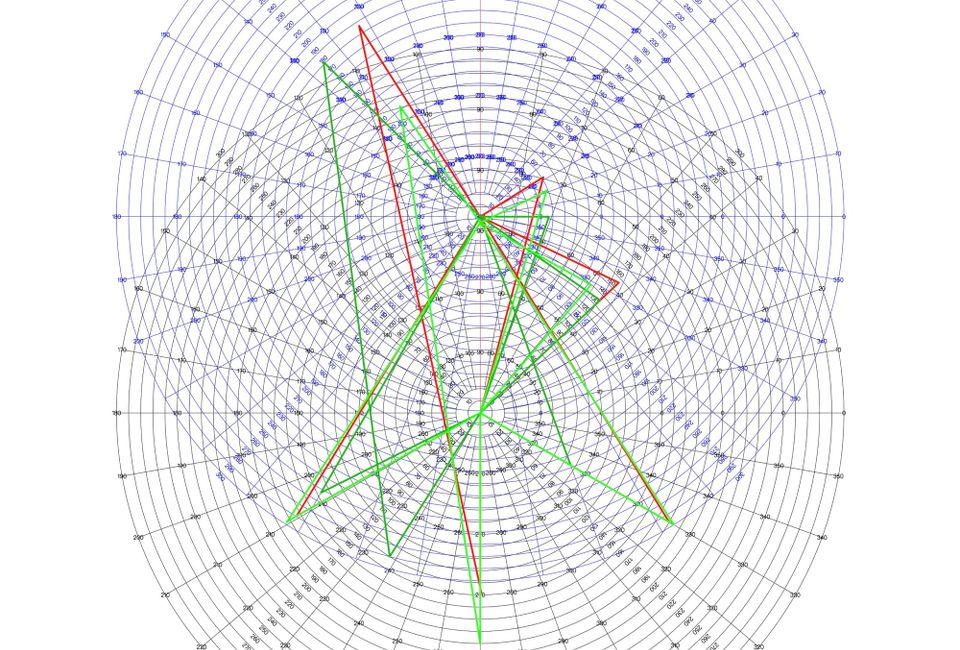
Continuing the quest started with "a guitar fit", I've started to think about how one would map the contact points of a guitar in a meaningful way from an ergonomic perspective. What you see above is not likely to be it, but creating it has been a learning experience. Seeing how different guitar models map into it is raising new questions and moving things along.
The idea was as follows:
- Create one coordinate system with angles and distances from the center of the bridge, i.e. at the nominal location of a string's anchor point along the center line (in between the 3rd and 4th strings on a 6-string guitar).
- Create a second identical coordinate system at the center of the 24th fret - if the guitar has fewer than 24 frets, it will fall where the 24th fret would have been.
- Measure the angles and distances in the respective coordinate systems to the following points:
- Where the right arm rests - although maybe this has to be a range of "playable" angles?
- Where the lower cutaway bottoms out - determines how easy it is to reach the upper frets
- The deepest point of the bottom waist- determines how high the guitar sits off the lap
- The farthest point at the lower bout - determines whether/how the guitar can sit on the left leg (assuming a right-hand picking player)
- The strap button locations, including the distance between them - determines partly how the guitar will balance when played standing
As I mapped out these dimensions on a few guitar models (an S-style guitar - red in the images, a Les Paul-style guitar - light green in the images, and a Boden guitar - dark green in the images), I realized a few things. Apart from the coordinate systems appearing quite cluttered, it would probably be difficult to find some points accurately, since all surfaces are curved. The clutter can probably be reduced with some graphic design, but whatever measurements are decided upon have to be defined so that there is a way to measure them deterministically and be easily understood. This was a realization I came to about half way through, and as you can see in the below images, I already moved away from measuring the lower bout as described above, and instead measuring it at a 30 degree angle from the bridge. It turned out that the most likely contact point for the right arm would also land approximately at a 30 degree angle from the bridge in the opposite direction, so maybe it makes sense to just standardize on this instead? I have noticed that many Strandberg players rest the guitar using the leg cutaway resting on the right leg, where the contact point would be roughly in this location. Other body styles don't really allow this playing position at all, but this measurement would roughly decide how the guitar would rest when placed on the right leg (NOTE: the AI panel didn't quite catch the part about the leg cutaway, but confused it with the lower waist of the guitar). Further analysis of actual player postures will have to be carried out to answer this. Additionally, the above approach would lead to quite a large number data points to capture and compare, so it should probably be simplified.
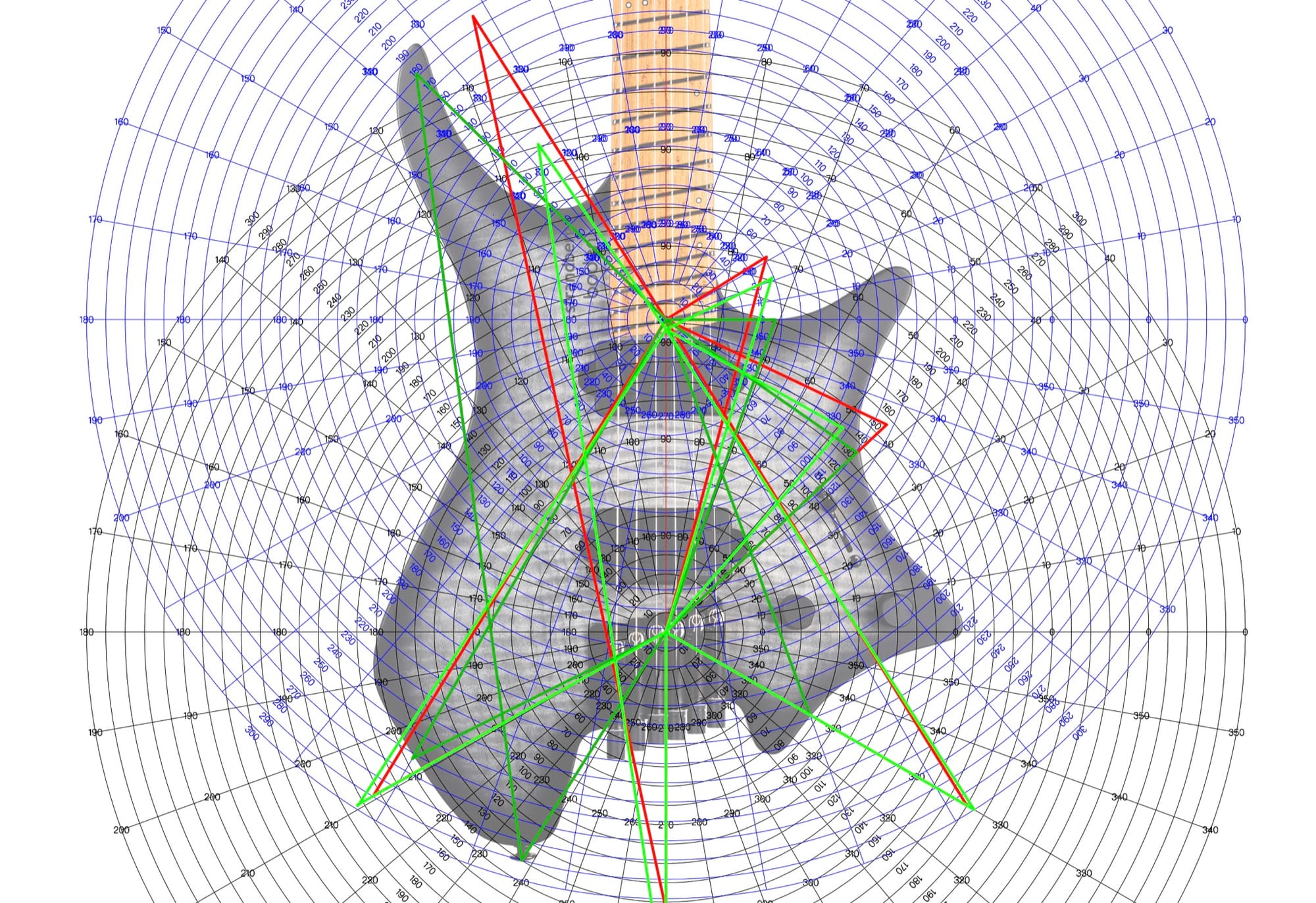
Additionally, coordinates that determine how far away from the player's centerline (as drawn between the shoulders) the guitar will rest need to be created.
So to summarize, no actual results here, but letting you know where things are heading and giving you a chance to react, respond, and influence. I tend to work in this fashion: iterate in my head for some time, and then prototype/test each piece at a very early stage. Even if that first stage fails, it will inform and influence the next iteration. If I do more than one stage in one go, and the first one turns out to not work, chances are that there will be knock-on effects. There are many steps left on this concept, so I want to get this one out there first.
I forgot to mention that there was no AI involved in the creation of the previous post. Perhaps the typos and mistakes in the initial version that went out via e-mail proved that fact 😅 Also, there was no AI involved in this one!
Having said that, I will do an experiment and challenge the AI panel for more than just their usual reactions, which tend to be more about the process and seeking answers than providing actual input. So, Iain, Daiter, and Kai, please use your expertise in guitars, guitar playing, and design, and research for me what different postures players tend to have when playing seated, and how different body shapes seem to affect the angle at which the player leans the guitar. How does this affect the angles of the arms, wrists and shoulders depending on the size of the player? What do you think would be a meaningful way to measure and quantify the physical properties of a guitar body shape and how it relates to player posture? Do you have a suggestion on how to improve the coordinate system?
And for you, the reader, you will have to listen to the podcast to hear what the panel had to say.
AI Panel Commentary (+ Podcast!)
The panelists:
Blaine Segway - moderator (female, but the others think she is male)
Iain Footnote - brand historian, knows "everything" about the brand
Daiter Lesmore - knows Dieter Rams' 10 Principles of Good Design like his own
Kai Fretwell-Wayback - pro musician and general skeptic
They were created as prompts in Claude, and asked to comment on the post above in order, including to react on what anyone before had said. The script was then uploaded to ElevenLabs and voices assigned to the respective text blocks. No edits were made to the script that was generated.
Feel free to continue the discussion in the comments!
The sources that the AI Panel reference
Read in full: the PLOS ONE paper, the rhooper.com page and the Guitar World interview. Everything else was checked at abstract or summary level, as noted.
- Correlations between body postures and musculoskeletal pain in guitar players (Portnoy et al., PLOS ONE, 2022): peer-reviewed; 25 players, 22 men; seated versus standing joint angles, hand-span link, pain prevalence cited from earlier studies.
- Analyzing working conditions for classical guitarists: design guidelines for new supports and guitar positioning (Valenzuela-Gómez et al., Work, 2020): peer-reviewed; nine students; abstract-level only.
- Motion Capturing for the Evaluation of Ergonomically Designed Guitars (Verwulgen et al., 2019): book chapter; two players; abstract-level only.
- Electric Guitar Ergonomic Analysis (rhooper.com): weak source. One person's personal website, not peer-reviewed. Used for the metric set, tilt ranges and lineage claims, which Iain flags as unchecked.
- Behind the rise of Strandberg and its headless revolution (Guitar World, 2025): trade-press interview, sponsored by Strandberg; Ola's own account, not independent.
- ISO 7250-1:2017, Basic human body measurements for technological design: standard; abstract and published summaries only, not the purchased text.
- ISB recommendation on joint coordinate systems, Part II: shoulder, elbow, wrist and hand (Wu et al., 2005): abstract-level only.
- H-point (Wikipedia): secondary source for the SAE J826 template and manikin description.
- Evaluation of the Seat Index Point Tool (UMTRI, 2014): basis for the caution that the standard manikin misreads torso angle.
- Anthropometric Database, ANSUR II (US Army Public Health Center): sample sizes and sitting measures; military population.
- Neuromotor variability partially explains different endurance capacities of expert pianists: the closest thing found on posture variability and fatigue; pianists, not guitarists; surfaced via search, not read in full.
Member discussion